Kitchen lighting options for under cabinet spaces are transforming modern kitchens, moving beyond simple illumination to become integral elements of design and functionality. Properly implemented under-cabinet lighting not only enhances task performance during food preparation but also adds a sophisticated aesthetic touch to the heart of the home. This guide explores the diverse range of lighting solutions available, from energy-efficient LED strips to sleek linear bars and versatile puck lights, helping you create a beautifully lit and highly practical kitchen environment.
Effective under-cabinet lighting is particularly beneficial in areas where shadows often fall – around sinks, cooktops, and countertops. It minimizes eye strain, improves visibility for precise work, and highlights the textures and colors of your kitchen’s surfaces. Understanding the different types of lighting, their installation requirements, and the nuances of color temperature and brightness is key to achieving optimal results.
Illuminating Your Kitchen: A Guide to Under-Cabinet Lighting
The kitchen is often considered the heart of the home, and a well-lit kitchen is a functional and inviting space. While overhead lighting provides general illumination, under-cabinet lighting offers a targeted solution for enhancing task areas and adding a touch of sophistication. This guide explores the various options available for under-cabinet lighting, covering everything from installation to maintenance, to help you create the perfect ambiance for your culinary endeavors.
Adding illumination beneath your kitchen cabinets isn’t just about aesthetics; it’s about practicality and safety. Properly placed lighting eliminates shadows on countertops, making food preparation safer and more efficient. It also highlights the beauty of your backsplash and countertops, creating a more visually appealing kitchen environment. Under-cabinet lighting is particularly effective in areas where you frequently chop, mix, or cook, such as near the sink, stove, and food preparation zones.
Introduction to Under-Cabinet Lighting
Under-cabinet lighting significantly improves task performance by providing focused illumination directly where it’s needed. This reduces eye strain and allows for greater precision when working with knives or reading recipes. Beyond functionality, it dramatically enhances the kitchen’s aesthetics, adding depth and dimension. The soft glow can create a warm and welcoming atmosphere, making the kitchen a more enjoyable space to spend time in.
Common areas benefiting from this type of lighting include above countertops, inside cabinets (for showcasing glassware or decorative items), and around sinks.
The market offers a diverse range of under-cabinet lighting options, each with its own advantages and disadvantages. These include LED strip lights, puck lights, and linear bar lights. Each type differs in terms of installation complexity, light distribution, and overall cost. Understanding these differences is crucial for selecting the best solution for your specific needs and kitchen layout.
LED Strip Lighting: A Comprehensive Look
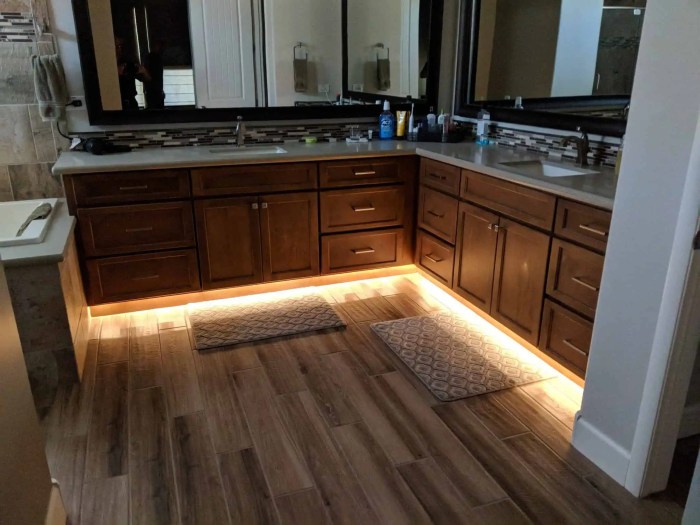
Source: ledyilighting.com
LED strip lights consist of a flexible circuit board populated with surface-mounted LEDs. They typically operate on low voltage (12V or 24V) and require a power supply to convert standard household voltage. The strips are often equipped with an adhesive backing for easy installation. Their flexibility allows them to conform to the contours of cabinets and provide continuous, even illumination.
The energy efficiency, long lifespan, and minimal heat output of LEDs make them a popular choice for under-cabinet lighting.
Calculating the required length of LED strip lighting is straightforward. Simply measure the linear footage of the cabinets you intend to illuminate. It’s always a good idea to add a few extra inches to account for corners and connections. For example, a standard 10-foot kitchen run with cabinets on both sides might require approximately 25-30 feet of LED strip lighting.
Color temperature plays a significant role in the overall ambiance of your kitchen. Here’s a comparison of common color temperatures:
| Color Temperature (Kelvin) | Description | Best Use Cases | Potential Drawbacks |
|---|---|---|---|
| 2700K – 3000K | Warm White | Creating a cozy and inviting atmosphere; highlighting warm-toned cabinets and countertops. | Can appear too yellow in some kitchens; may not provide sufficient brightness for detailed tasks. |
| 3500K – 4000K | Cool White | Providing a balanced and neutral light; suitable for kitchens with white or gray cabinetry. | Can feel sterile or clinical if used excessively. |
| 5000K – 6500K | Daylight | Maximizing brightness and clarity; ideal for tasks requiring high visibility, such as food preparation. | Can appear harsh and unflattering; may wash out colors. |
Puck Lighting: Installation and Applications, Kitchen lighting options for under cabinet spaces
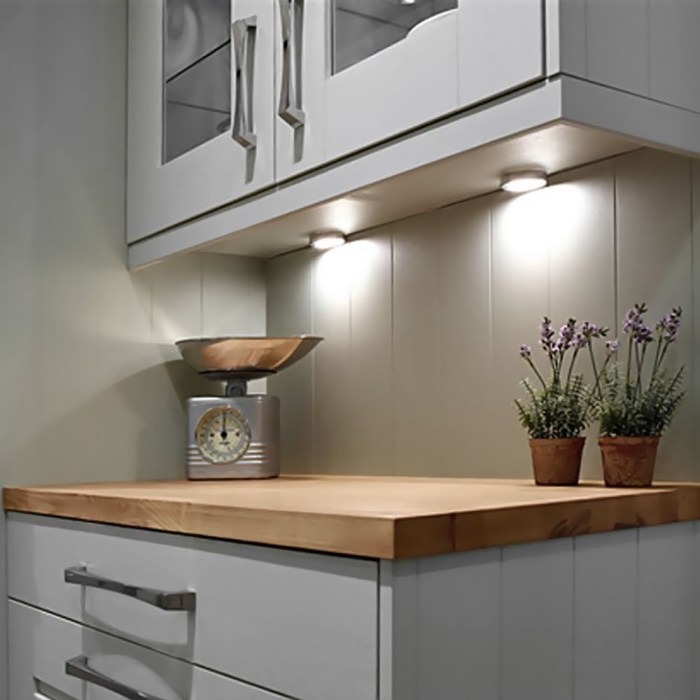
A typical puck light system comprises individual light fixtures (the “pucks”), a power supply, and connecting wires. The pucks themselves contain LEDs and are usually encased in a metal or plastic housing. Installation involves mounting the pucks under the cabinets and connecting them to the power supply. Puck lights offer a focused beam of light, making them suitable for highlighting specific areas.
Puck lights can be mounted using adhesive strips or screws. Adhesive mounting is simpler and requires no drilling, but it may not be as secure as screw mounting, especially on textured surfaces. Hardwired puck light systems offer a clean and permanent installation, while plug-in systems are easier to install and remove. Hardwired systems require electrical knowledge and adherence to local codes.
Plug-in systems are convenient but may require visible cords.
To eliminate shadows, space puck lights evenly under the cabinets. A general rule of thumb is to place them 6-12 inches apart. Consider overlapping the beams of light slightly to ensure complete coverage. For deeper cabinets, you may need to use more puck lights or choose models with a wider beam angle.
Linear Bar Lighting: Modern and Sleek
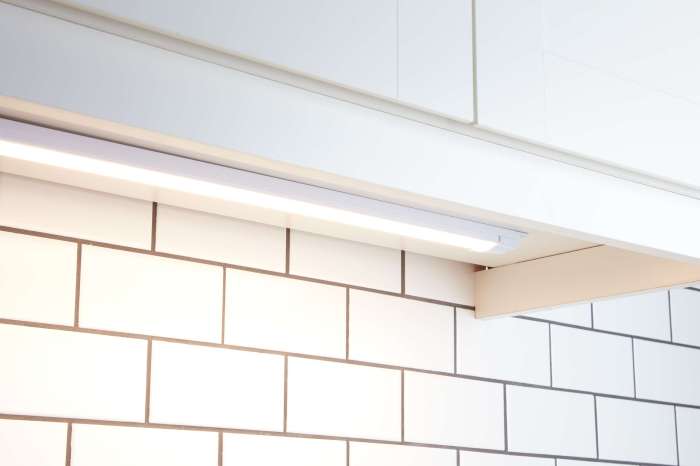
Linear bar lights are characterized by their long, slender design. They typically feature a row of LEDs encased in an aluminum housing. These lights often offer a more modern and sophisticated look compared to puck lights or LED strips. They are available in various lengths and finishes to complement different kitchen styles.
Linear bar lights differ from LED strip lights in their light distribution and appearance. LED strips provide a diffused, continuous glow, while linear bar lights emit a more focused beam of light. The bar format also creates a distinct visual element, adding a touch of architectural interest. The light is more directional, making it ideal for highlighting specific areas or features.
Selecting the appropriate length and wattage for linear bar lights depends on the size of the area you want to illuminate. Measure the length of the cabinet run and choose a bar light that is slightly shorter. Wattage determines brightness; higher wattage equates to more light output. Consider the depth of your cabinets and the color of your countertops when choosing wattage.
For example, darker countertops may require higher wattage to achieve adequate illumination.
Many modern kitchen designs prominently feature linear bar lighting. They are often used to illuminate countertops, backsplashes, and open shelving. The sleek and minimalist design of linear bar lights complements contemporary kitchen styles, adding a touch of elegance and sophistication.
Under-Cabinet Lighting Power Sources
There are three primary power sources for under-cabinet lighting: direct wiring, plug-in transformers, and battery-powered options. Direct wiring involves connecting the lights directly to the home’s electrical system. Plug-in transformers convert standard household voltage to the low voltage required by LED lights. Battery-powered options are convenient for areas where wiring is difficult or impossible, but they require regular battery replacements.
Safety is paramount when dealing with electrical installations. Direct wiring should only be performed by a qualified electrician. Plug-in transformers should be UL-listed and used with appropriate wiring. Battery-powered lights should be used in accordance with the manufacturer’s instructions. Always disconnect power before working with any electrical components.
Concealing wiring is essential for a clean, professional look. Use wire channels or conceal wires within the cabinet structure. Avoid running wires across open areas where they could be a tripping hazard. Consider using wireless options where possible to minimize the need for wiring.
Electrical code requirements for under-cabinet lighting installations vary by location. Here’s a general Artikel:
- All wiring must comply with local electrical codes.
- GFCI (Ground Fault Circuit Interrupter) protection is required in kitchens.
- Low-voltage wiring must be properly insulated and protected.
- Connections must be made using approved connectors.
- Installations should be inspected by a qualified electrician.
Light Color and Brightness Considerations
Source: easydecor101.com
Lumens measure the total amount of visible light emitted by a light source. Higher lumen output equates to brighter light. The appropriate lumen output depends on the cabinet depth and countertop material. Deeper cabinets and darker countertops require higher lumen output. A general guideline is to aim for 300-500 lumens per linear foot of countertop.
The Color Rendering Index (CRI) measures how accurately a light source renders colors compared to natural sunlight. A higher CRI (closer to 100) indicates more accurate color rendering. In the kitchen, a high CRI is important for accurately assessing the color of food and other items. A CRI of 80 or higher is generally recommended.
For cabinets with a depth of 12-18 inches, a lumen output of 400-600 lumens per foot is often sufficient. Darker countertops, such as black granite, may require 600-800 lumens per foot. Lighter countertops, such as white quartz, may only require 300-400 lumens per foot. Different light colors affect the perception of kitchen colors and textures. Warm white light enhances warm tones, while cool white light accentuates cool tones.
Smart Under-Cabinet Lighting Systems
Smart under-cabinet lighting systems offer advanced features such as dimming, color control, and scheduling. These systems can be controlled remotely via a smartphone app or voice assistant. They allow you to customize the lighting to suit your mood and activities. Some systems also offer integration with other smart home devices.
Smart lighting can be integrated with other smart home devices, such as smart thermostats and security systems. For example, you could program the lights to turn on automatically when you enter the kitchen or to dim when you start a movie in the adjacent living room. This creates a seamless and integrated smart home experience.
Voice control adds another layer of convenience to smart under-cabinet lighting. You can simply use voice commands to turn the lights on or off, adjust the brightness, or change the color. This is particularly useful when your hands are full or when you’re cooking.
Imagine this scenario: You’re preparing dinner. As you begin chopping vegetables, you say, “Alexa, turn on kitchen under-cabinet lights to 70%.” The lights illuminate your workspace, providing ample visibility. As you move to the stove, you say, “Alexa, change kitchen lights to warm white.” The lights shift to a warmer tone, creating a more inviting atmosphere. After dinner, you say, “Alexa, turn off kitchen lights.” The lights turn off, leaving you with a clean and relaxing space.
Installation Techniques and Tools
Installing LED strip lights under cabinets typically involves cleaning the cabinet surface, peeling off the adhesive backing, and pressing the strip firmly into place. Ensure the surface is clean and dry before applying the strip. For corners, carefully bend the strip to conform to the shape of the cabinet. Use clips or connectors to join sections of strip lighting if necessary.
Essential tools for a successful installation include a drill, screwdriver, wire strippers, wire connectors, a measuring tape, and a level. A voltage tester is also recommended to ensure power is off before working with any electrical components. Safety glasses and gloves are also advisable.
Common installation challenges include dealing with uneven cabinet surfaces, concealing wiring, and making secure connections. Uneven surfaces can be addressed by using shims or adhesive pads. Wiring can be concealed using wire channels or by routing it through the cabinet structure. Secure connections are essential for reliable operation; use appropriate wire connectors and ensure they are properly tightened.
For hardwired systems, carefully strip the wires and connect them to the power supply using wire connectors. Ensure the polarity is correct. For plug-in systems, simply plug the transformer into a power outlet and connect the lights to the transformer. Always follow the manufacturer’s instructions.
Material and Finish Compatibility
Different cabinet materials affect lighting choices. Wood cabinets generally work well with any type of lighting. Laminate cabinets may require adhesive strips that are specifically designed for laminate surfaces. Metal cabinets can reflect light, so consider using diffused lighting to avoid glare. The cabinet material doesn’t necessarily dictate the lighting type, but it influences the mounting method and the overall aesthetic.
Selecting lighting fixtures that complement the kitchen’s overall style is crucial. Modern kitchens often benefit from sleek and minimalist lighting, such as linear bar lights. Farmhouse kitchens may look best with rustic or vintage-inspired fixtures. Traditional kitchens can be enhanced with classic and elegant lighting designs.
Lighting finishes should coordinate with popular cabinet colors. Brushed nickel and stainless steel finishes complement gray and white cabinets. Bronze and copper finishes pair well with warm-toned cabinets. Black finishes add a touch of sophistication to any kitchen.
| Kitchen Style | Recommended Lighting Type | Finish Suggestions |
|---|---|---|
| Modern | Linear Bar Lights, LED Strip Lights | Brushed Nickel, Stainless Steel, Black |
| Farmhouse | Puck Lights, Vintage-Inspired Fixtures | Bronze, Copper, Antique White |
| Traditional | Puck Lights, Decorative Fixtures | Brass, Polished Nickel, Crystal |
Maintaining and Troubleshooting Under-Cabinet Lighting
Source: thespruce.com
Routine maintenance tasks to prolong the lifespan of under-cabinet lights include dusting the fixtures regularly and checking the wiring for damage. Avoid using harsh chemicals or abrasive cleaners, as these can damage the finish. Periodically inspect the power supply and connections to ensure they are secure.
Common issues include flickering, dimming, and burnout. Flickering can be caused by loose connections or a faulty power supply. Dimming can be due to low voltage or a failing LED. Burnout indicates that an LED has failed and needs to be replaced. Identifying the cause of the problem is the first step towards resolving it.
Safely replacing LED strip lights or puck lights involves disconnecting power, removing the old fixture, and installing the new one. Follow the manufacturer’s instructions carefully. Ensure the new fixture is compatible with the existing power supply.
Here’s a troubleshooting guide:
Problem: Lights flicker.
Solution: Check all connections to ensure they are secure. Replace the power supply if necessary.
Problem: Lights are dim.
Solution: Verify the voltage is correct. Replace the LED strip or puck light if it’s failing.
Problem: Lights don’t turn on.
Solution: Check the power supply and wiring. Replace the fuse or circuit breaker if necessary.
Conclusive Thoughts: Kitchen Lighting Options For Under Cabinet Spaces
In conclusion, selecting the right kitchen lighting options for under cabinet spaces involves careful consideration of your kitchen’s layout, style, and your personal preferences. Whether you opt for the seamless integration of LED strips, the focused illumination of puck lights, or the modern appeal of linear bars, the benefits are undeniable – improved functionality, enhanced aesthetics, and a more enjoyable cooking experience.
Investing in quality under-cabinet lighting is an investment in the overall value and enjoyment of your home.
Remember to prioritize safety during installation, adhere to electrical codes, and explore smart lighting systems for added convenience and control. With a little planning and the right choices, you can illuminate your kitchen in a way that is both beautiful and practical, creating a space you’ll love for years to come.
Essential Questionnaire
What is the best color temperature for under-cabinet lighting?
Generally, warm white (2700K-3000K) is preferred for kitchens as it creates a cozy and inviting atmosphere. However, cool white (3500K-4100K) or daylight (5000K-6500K) can be used for more task-focused areas where accurate color rendering is important.
Can I install under-cabinet lighting myself?
Yes, plug-in systems are relatively easy to install for DIYers. However, hardwired systems require electrical knowledge and should be installed by a qualified electrician to ensure safety and code compliance.
How do I hide the wires for under-cabinet lighting?
Wires can be concealed using wire channels, routed through cabinet interiors, or hidden behind toe-kick panels. Careful planning during installation is crucial for a clean, professional look.
What is CRI and why is it important?
CRI (Color Rendering Index) measures how accurately a light source reveals the colors of objects. A higher CRI (80 or above is recommended) ensures that your kitchen surfaces and food appear more natural and vibrant.
How often do LED under-cabinet lights need to be replaced?
LEDs have a long lifespan, typically 50,000 hours or more. This translates to many years of use under normal conditions. However, they will eventually need replacing, and the lifespan can be affected by heat and voltage fluctuations.